Listening for University Lectures: 5 Practical Steps
A good IELTS Listening score is an achievement, but it is only the beginning. The next challenge comes when you enter an international university lecture theatre: a 60-minute lecture, fast speech, specialist vocabulary and no questions to guide your listening. How do you move beyond keeping up to understanding and using what you hear?
The answer is to actively develop your listening skills beyond exam preparation and into academic study. Here are five practical steps to help you make that transition.
The difference between exam listening and classroom lectures can come as an academic culture shock. Understanding that difference is the first step towards a useful practice plan.
Purpose: In IELTS Listening, you listen for information to answer questions. In a lecture, you need to understand ideas in depth, analyse them and bring information together.
Pace and length: IELTS recordings are relatively short and paced for the test. Real lectures are much longer, with natural speech that may include slang and regional accents.
Content: General listening practice covers familiar topics. University lectures introduce specialist terminology and abstract concepts.
Bridging that gap takes a structured plan for developing your listening.
Authentic material such as TED Talks can help you prepare for academic listening.
5 steps to prepare for university lectures
This takes consistent practice, with an emphasis on listening actively rather than waiting for information to register.
1. Build your academic vocabulary
Vocabulary is a foundation of comprehension: unfamiliar words make ideas harder to follow. Look beyond your usual IELTS vocabulary lists and work with the Academic Word List (AWL). It brings together words commonly used in academic contexts. Learn them in context rather than in isolation:
Read articles, journals and introductory textbook chapters in the subject you plan to study.
Note new words and, especially, how they are used in complete sentences.
Write your own sentences with new vocabulary to make it part of your working knowledge.
2. Practise with TED Talks and online lectures
Start moving beyond IELTS recordings. Authentic academic material helps you get used to the pace and style of real lectures. Sources to explore include:
TED Talks and TED-Ed: Clearly structured talks, accurate subtitles and varied topics make these a useful starting point. You can find thousands of videos on the TED website.
Coursera and edX: These platforms offer free course options from universities around the world. Find an introductory course in your subject and use its lectures for listening practice.
YouTube: Channels such as CrashCourse and Khan Academy present educational topics in an engaging way.
A listening routine: First, listen without subtitles to follow the main idea. Listen again and take notes. On your third listen, use English subtitles to check your understanding and learn new words.
3. Recognise lecture structure and signposting
A well-organised lecture has a logical structure. Lecturers often use signposting language to help you follow it. Practise recognising phrases such as these:
Introducing the structure: “Today, I’m going to cover three main points. First…, second…, and finally…”
Emphasising a key point: “The most important point is…”, “This is crucial to understand…”
Moving to another point: “Now, let’s move on to…”, “Turning to the next point…”
Summing up: “To sum up…”, “In conclusion…”
These signals act like a map, helping you follow a long lecture without losing the thread.
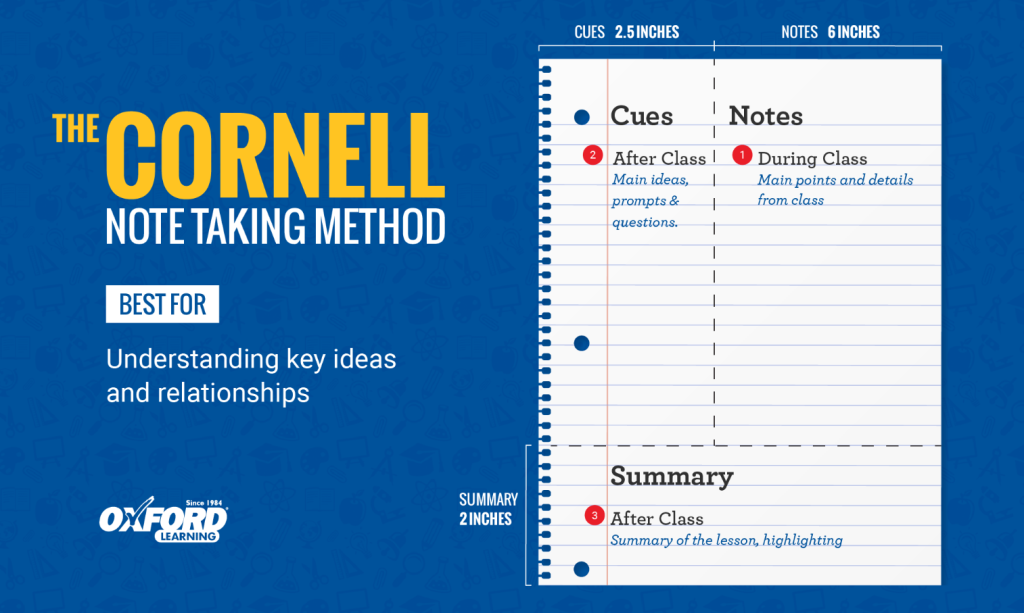
Useful notes capture the main ideas rather than every word. Source: Oxford Learning Centers
4. Develop useful note-taking habits
You cannot, and do not need to, write down every word a lecturer says. Aim to capture the main ideas, important examples and questions that arise. Try these approaches:
The Cornell method: Divide the page into three sections for main notes, keywords or questions, and a summary. This helps you organise the information.
Mind mapping: Put the main idea in the centre and draw related ideas around it. This is useful for lectures with several connected strands.
Practise taking notes while listening to online lectures. You can also explore effective note-taking methods for students in more depth.
5. Listen critically
This is a more advanced level of listening (related student story in Vietnamese). Take an active, questioning approach rather than simply receiving information. As you listen, ask yourself:
What is the speaker’s main argument?
Is the evidence convincing?
Do I agree with this view? Why?
How does this relate to what I already know?
Critical thinking helps you stay focused, retain information and make the ideas you hear part of your own knowledge.
Putting it into practice: Developing your academic listening skills is an investment in your preparation for studying abroad. It helps you understand lectures while building critical thinking and independent study skills. Work through these five steps consistently to prepare for university teaching and take a more active part in academic life.